

Shackle Misuse: The five things riggers get wrong and why they matter
Five mistakes account for most of the shackles Ranger takes out of service: the wrong fitting for the configuration, a screw pin that can back out, a substituted pin, grade confusion, and a shackle that has been altered. None of them are exotic. Most of them are catchable before the lift starts with a proper pre-use check – read the markings, confirm the pin is the right one and fully seated, look over the condition, and think about how the load is actually going to sit in the shackle.
This article covers conventional forged lifting shackles to AS 2741 – Grade M and Grade S. Special-purpose products such as wide-body, ROV, sling and some international-standard shackles carry different ratings and their own manufacturer limits. Where this article and a manufacturer's instructions differ, the instructions govern.
Key terms
WLL – working load limit
The maximum load the shackle is rated to carry in a straight, in-line pull. AS 2741–2002 uses WLL; it replaced the older term SWL. See WLL vs SWL explained.
Bow (anchor) shackle
Rounded body with a wide bow. The fitting for two-leg or angled work – the bow lets the legs find their own line without prising the body open.
Dee (chain) shackle
Narrow D-shaped body. A standard AS 2741 dee shackle is intended for single-leg, in-line loading; the narrow throat is what makes it strong along the centreline.
Grade M and Grade S
The two quality grades under AS 2741 – Grade M (Grade 4) and Grade S (Grade 6). At the same nominal size, a Grade S shackle commonly carries about twice the WLL of a Grade M.
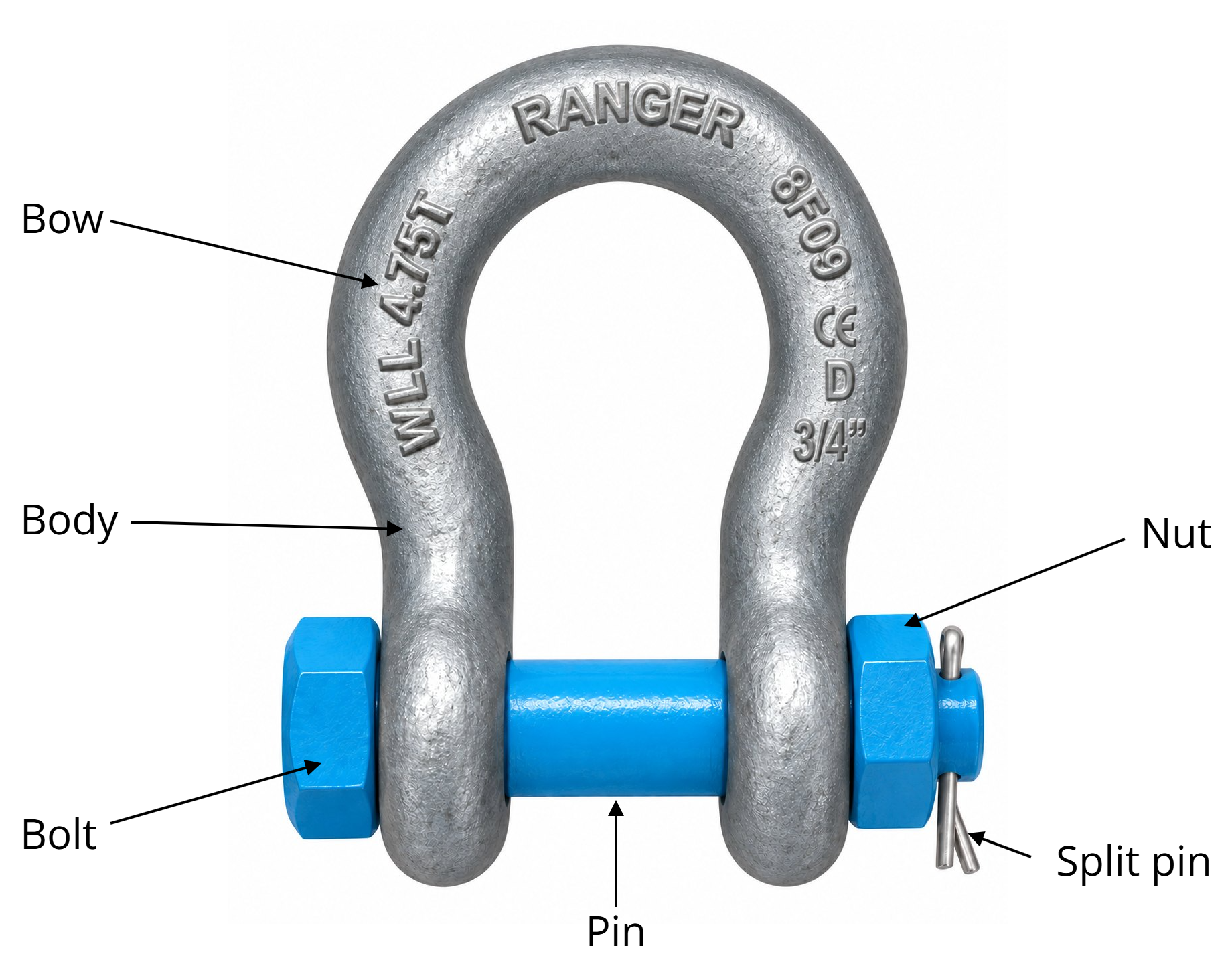
Anatomy of a shackle
Check all components and markings are present and legible before every lift.
Typical markings

Manufacturer’s name or logo

WLL (Working Load Limit)

CE mark (if applicable)
Traceability / batch code

Material grade (e.g. D)
Size (e.g. 3/4″)
Note
Markings and components may vary by manufacturer and shackle type (e.g. Dee or Bow).
1
Side loading, and why a dee shackle takes one leg only
A shackle is rated for a pull along the centreline of its body. Load it at an angle to that line and the usable WLL drops, and it drops faster than most people expect. A standard AS 2741 dee (chain) shackle is intended for single-leg, in-line loading – two legs in a dee shackle load the narrow body off-axis.
Where you need to collect two legs, use a bow shackle. Keep the included angle between the legs to 120° or less, and do not run more than two legs into one shackle. AS 2741 itself calls for deration once the included angle exceeds 60°, with the manufacturer consulted beyond that.
Dee vs bow shackle – correct use
Use the correct shackle for the application and avoid side loading.
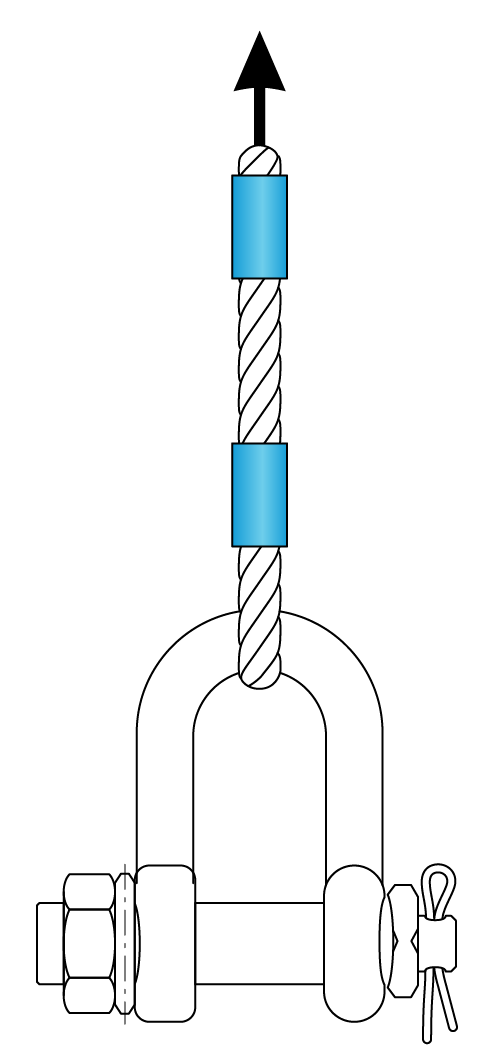
✓CORRECT
Dee shackle with single leg load in line
with shackle centreline.
with shackle centreline.
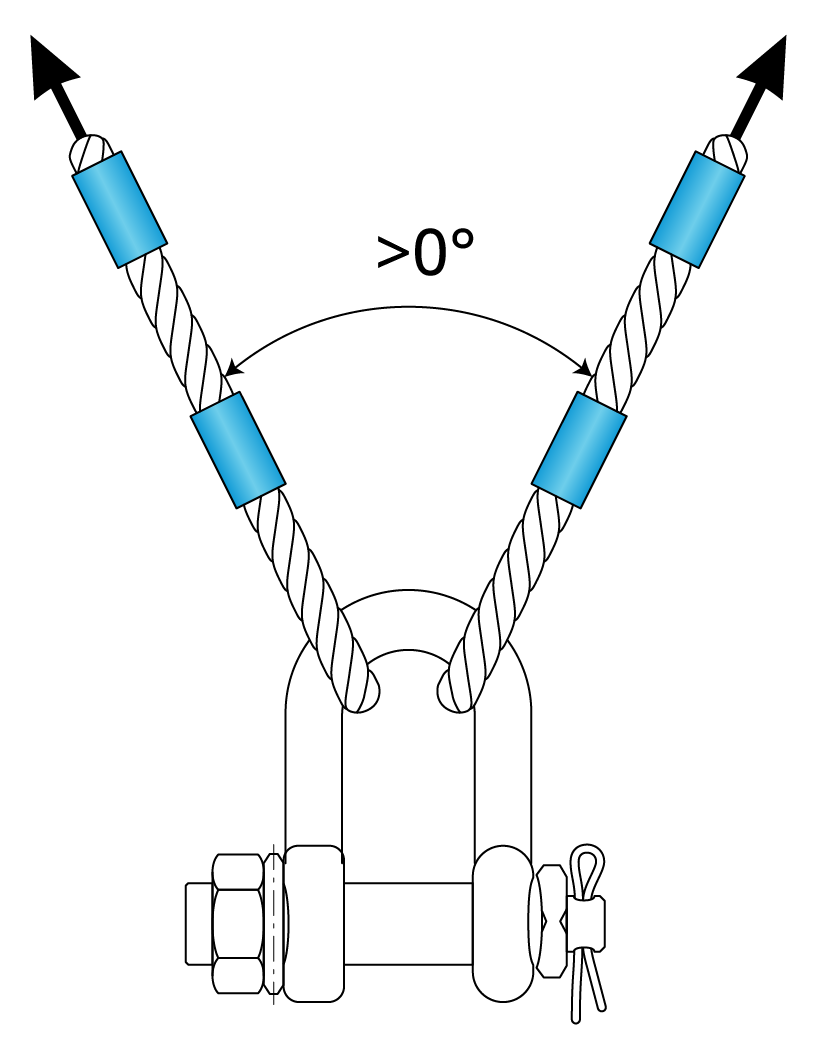
✕INCORRECT
Dee shackle with two legs causes side loading.
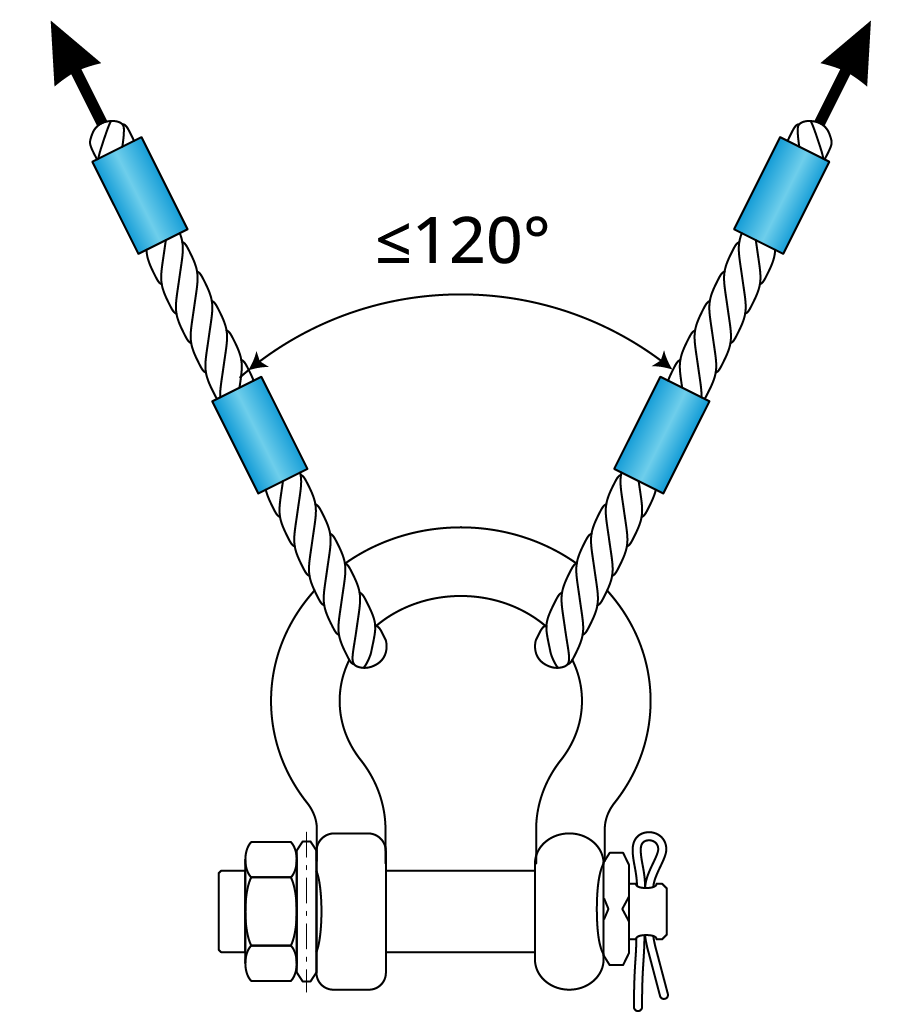
✓CORRECT
Bow shackle with two legs seated in the bow.
Keep included angle ≤ 120°.
Keep included angle ≤ 120°.
The legs sit in the bow, to the manufacturer's instructions – not crowded onto the pin, where they create eccentric loading and concentrate load toward one eye of the shackle. That is not the same as saying the pin never carries load: shackle pins are load-bearing components, and some manufacturers specifically permit the pin to be loaded where the load is correctly centred.
The figures below are a typical published derating for conventional screw-pin and bolt-type shackles. They are an example, not a rule: AS 2741 publishes no universal side-load table, and curves differ between manufacturers.
Side loading reduces shackle capacity
As the load angle increases, the effective WLL decreases.
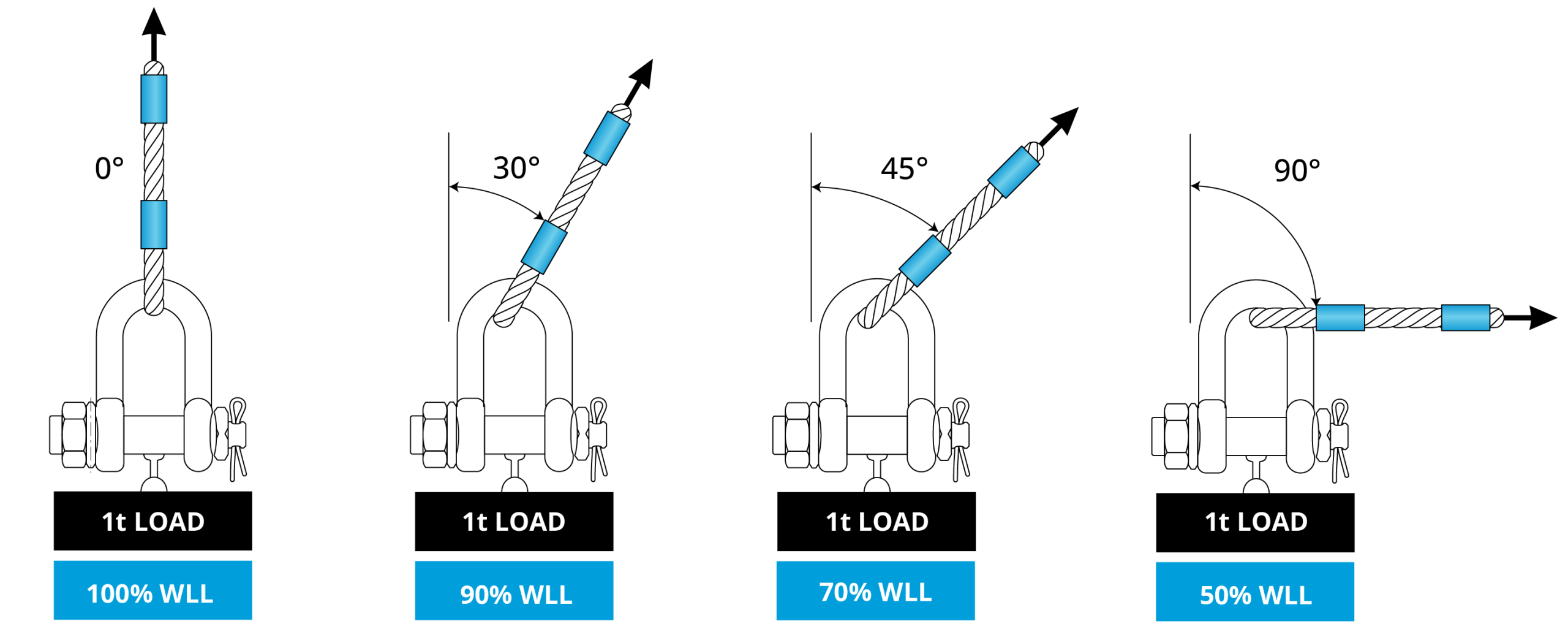
Typical WLL reduction for side loading
| LOAD ANGLE (FROM VERTICAL) | % OF RATED WLL |
|---|---|
| 0° | 100% |
| 15° | 95% |
| 30° | 90% |
| 45° | 70% |
| 60° | 60% |
| 75° | 55% |
| 90° | 50% |
Work to the side-load chart for the shackle actually in your hand. These numbers show the size of the penalty; they are not a rating.
What comes back off site
A dee shackle that has been run with two legs commonly presents with the throat opened and the pin flats polished on one side where the legs have been dragging across them. Sit it on a flat bench next to a new one of the same size and it often rocks. By the time it looks like that, it has already done the lift.
2
Screw pin vs safety bolt – when a screw pin is not enough
Screw pin shackles are for non-permanent work, where the shackle is fitted, used and removed under supervision. Bolt-type shackles (bolt, nut and cotter pin) and fixed-nut types are generally preferred for permanent or prolonged installations, and wherever movement of the load could rotate the pin.
Vibration is where manufacturers diverge, so this one goes by the instructions for the shackle you have. Some permit a screw pin to be moused as secondary retention in vibration-prone or long-term service; others call for a bolt-type or fixed-nut configuration outright. Mousing is a secondary control, not a substitute for the type the manufacturer specifies.
Whichever type you are on, the pin gets checked for tightness before every lift, not once at the start of the shift. And a bolt-type shackle running without its cotter pin is not a bolt-type shackle. It is a worse screw pin shackle, because nobody is treating it like one.
What comes back off site
Repeated movement can leave a polished wear ring around the eye face where the collar has been backing off and reseating. The galvanising commonly goes in that ring and nowhere else – one of the signs inspectors look for when a pin has been working loose in service.
3
Substituting a shackle pin with a bolt
Do not substitute pins. Body and pin are a matched, rated pair, and a replacement must be the manufacturer-approved pin specified for that shackle model, size and grade. A bolt, a length of bar or another manufacturer's pin voids the rating – the assembly is no longer a rated shackle and no WLL can be claimed for it.
The pin also has to seat properly. It must penetrate the full depth of the threaded eye with the collar bearing against the face of the eye. If it will not seat – bent pin, damaged or over-tight thread, misaligned holes – the shackle is out of service. Not adjusted, not persuaded. Out.
It is one of the most common findings off site, for an obvious reason: a substituted pin looks like it works. It goes through, it does up, the lift happens. Nothing tells the person using it that the rating stamped on the bow no longer applies.
What comes back off site
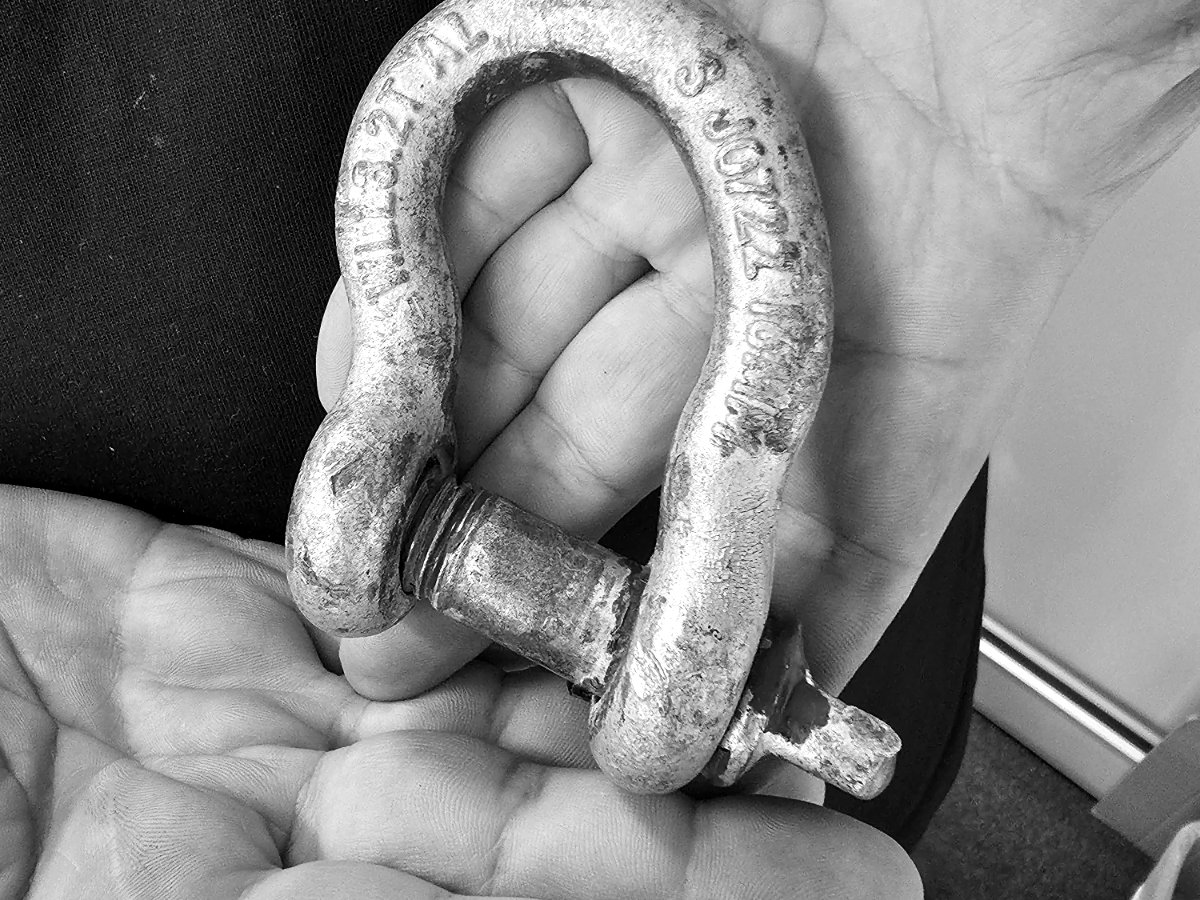
A substituted bolt commonly presents on the bench as a rolled thread running the full length instead of a shoulder, a head sitting proud of the eye instead of a seated collar, and no matching grade or maker's mark. In the air, at height, in gloves, it just looks like a pin.
4
Grade M vs Grade S, and unrated shackles in lifting service
Read the grade, not just the size. Grade S (Grade 6) commonly carries about twice the WLL of Grade M (Grade 4) at the same nominal size. A rigger who reads a size and assumes a WLL from memory will overload a Grade M fitting sooner or later.
Under AS 2741–2002, Clause 7 sets what has to be on the shackle:
- Manufacturer identification – the maker's mark.
- Quality grade – M or S.
- WLL – the rating.
- A batch or trace code – what ties the fitting back to its test documentation.
A shackle whose markings cannot be read is a shackle with no rating, regardless of how sound it looks. There is no path from a good-looking unmarked shackle back to a WLL. Cross-check what you read against the WLL charts rather than working from memory.
One thing worth clearing up, because it causes real confusion on site: galvanising is not the distinction. It is a corrosion-protection finish, and plenty of rated Grade S lifting shackles are hot-dip galvanised. The real line is between shackles manufactured and rated for lifting service and commercial or general-purpose shackles that are not. Ranger stocks both. Commercial gear is a legitimate product for non-lifting work – restraint, fencing, rigging of static gear – and it must not enter a lifting configuration. You tell them apart by the markings, not the finish.
On SWL: AS 2741–2002 removed the term safe working load to align with international practice, and WLL is the current terminology. A shackle stamped SWL is not automatically non-compliant – it may simply predate the current edition. What matters is whether the rating you are relying on is traceable to legible markings and documentation, rather than to what someone on site remembers about it.
What comes back off site
Unrated shackles turn up in rated kits more often than anyone expects, and commonly present as a bare bow carrying a size and nothing else – no maker's mark, no grade letter, no trace code. Whoever put it in the kit was matching a size, not reading a stamp.
Shackles & Turnbuckles Range →
5
Welding, heating and altering the geometry
Never weld, heat, bend, machine or otherwise alter a shackle in the field. If one has been altered, take it out of service and refer it to the manufacturer or a competent person. Do not assume that a proof test restores the original WLL or makes an altered shackle fit for continued use.
That includes the well-meant fixes. Do not narrow the jaws to close a gap, and do not weld washers or spacers inside the eyes – both change the WLL. Where a sling eye is narrower than the jaw and needs centring, a loose spacer on the pin is the accepted approach where the manufacturer permits it: it stops the eye wandering without altering the shackle.
Point loading – load over a small contact area rather than a flat bearing surface – may be acceptable where the manufacturer permits it, provided the load is correctly centred and applied to the product instructions. Sharp edges have to be avoided, and the configuration is limited by the lowest-WLL component in it.
A spread or elongated body, or a shackle that has been jammed open to get something into it, is a discard item. It does not go back in the box.
What comes back off site
A spread bow often announces itself before you measure anything: the pin drops through loose where it used to thread up snug. Heat can show through galvanising as a dull, discoloured band around the weld or the heated section, and it does not polish out.
When should a shackle be replaced?
Any one of the following takes the shackle out of service. Not "monitor it" – out.
- Markings that cannot be read – manufacturer, grade, WLL or trace code.
- A mismatched pin, or any pin that is not the manufacturer-approved one for that shackle.
- Damaged threads, in the pin or in the eye.
- A pin that will not seat to full depth with the collar bearing on the eye face.
- Distortion, spread or elongation of the body.
- Wear reaching the manufacturer's stated discard limit for the body or pin.
- Nicks, gouges or cracks anywhere on the body or pin.
- Corrosion, particularly pitting at the bow or in the eyes.
- Any evidence of heat, welding, machining or modification.
Ranger's examination checklists set this out in the order a competent person works through it.
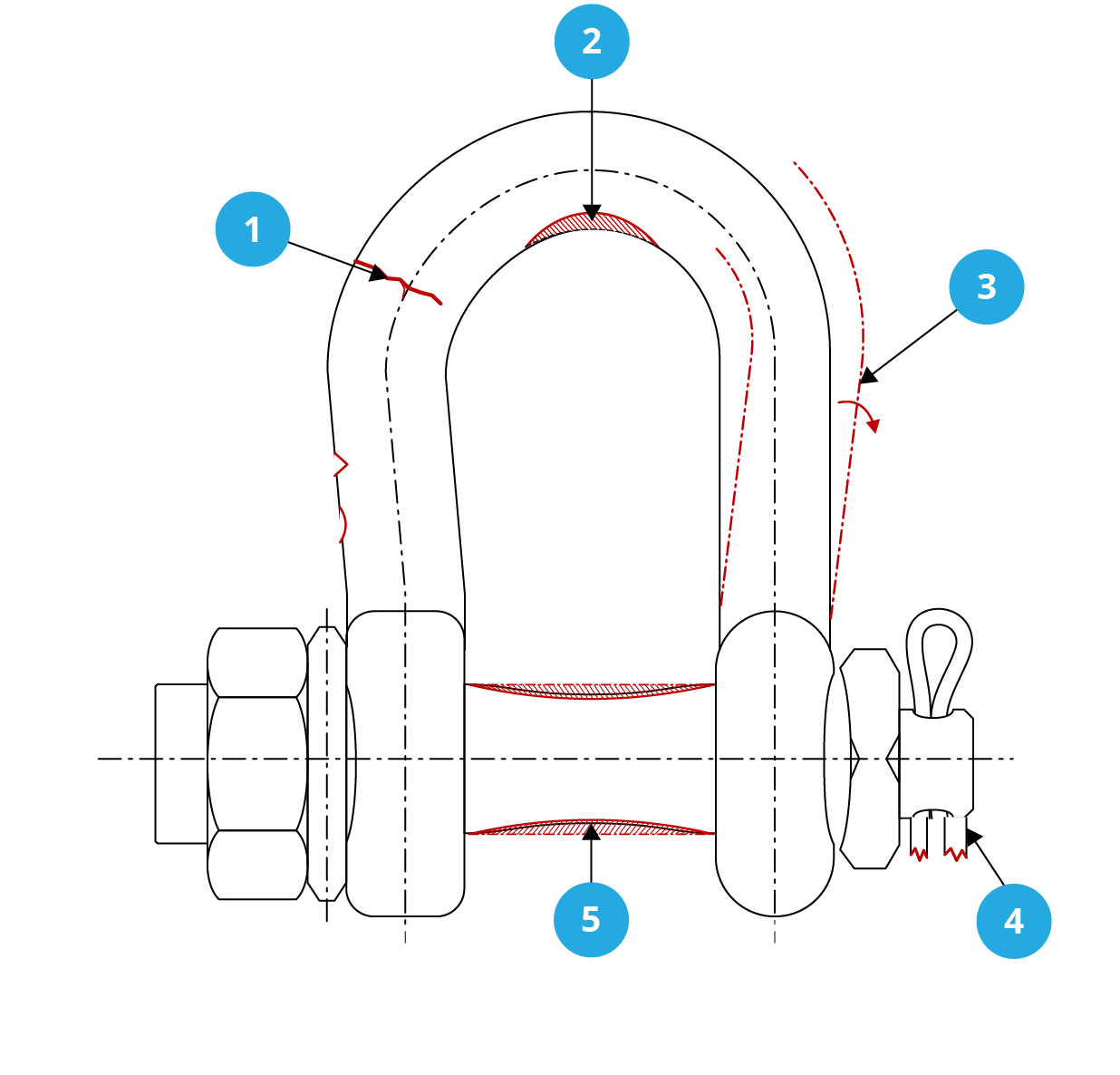
1Cracks, nicks or gouges
2Excessive wear (section reduction)
3Distortion (bent or twisted)
4Damaged or missing nut, retaining device
5Worn, bent or damaged pin
Who has responsibility for lifting gear on site?
The primary duty generally sits with the business, employer or person managing or controlling the plant – the PCBU in the harmonised WHS jurisdictions, and the employer under Victoria's OHS framework. Officers, workers and other parties carry duties as well, and the specific wording varies by jurisdiction.
However it is framed, it is discharged the same way: rated gear, inspected by a competent person at the required intervals, with records tying each fitting back to its documentation. The records are where most of the work sits – the Ranger Inspection Gateway holds them in one place rather than a folder in a site office.
Frequently asked questions
Can you side load a bow shackle?
Yes, within limits, with the derating applied. The WLL falls off the centreline – typically to around 70% at 45° and 50% at 90° for conventional shackles. Use the chart for the shackle in use; some types are rated in line only.
Can you use a dee shackle with two sling legs?
No. A standard AS 2741 dee (chain) shackle is intended for single-leg, in-line loading. Use a bow shackle: legs in the bow, included angle 120° or less, no more than two legs.
Do you have to mouse a screw pin shackle?
It depends on the manufacturer's instructions for that shackle. Some permit mousing as secondary retention in vibration-prone or long-term service; others require a bolt-type or fixed-nut shackle where movement could rotate the pin. Mousing does not replace the type the manufacturer specifies.
Can you use a bolt instead of a shackle pin?
No. Only a manufacturer-approved replacement pin for that shackle model, size and grade. A bolt, a length of bar or another manufacturer's pin voids the rating, and no WLL can be claimed afterwards.
Are galvanised shackles rated for lifting?
Galvanising says nothing about the rating – it is a corrosion-protection finish, and many rated lifting shackles, Grade S included, are hot-dip galvanised. The question is whether the shackle is manufactured and rated for lifting service; a commercial or general-purpose shackle must not be. Check the AS 2741 markings: manufacturer identification, quality grade, WLL and trace code.
My shackle is stamped SWL, not WLL – is it still good?
Not automatically non-compliant. AS 2741–2002 removed SWL in favour of WLL, and an SWL-stamped shackle may simply predate that edition. The test is whether the rating is traceable to legible markings and current documentation.
Key takeaways
✓Match the fitting to the configuration: standard dee shackles in line, bow shackles for angled and two-leg work at 120° or less.
✓Off the centreline, work to the manufacturer's side-load chart – not a remembered figure.
✓Body and pin are a matched pair. Only a manufacturer-approved replacement pin, seated to full depth.
✓Read the grade and the markings, not the size and not the finish. Galvanising is not a rating.
✓Never alter a shackle in the field. Out of service, and refer it on.
Standards and regulatory references
Key references for shackle selection, use and discard
AS 2741–2002 (Amdt 1 & 2)Shackles – the governing product standard for forged Grade M and Grade S shackles. Clause 6 mechanical properties, Clause 7 marking, Clause 8 testing of mechanical properties, Clause 9 quality control, Appendix B care and use.
WHS Act 2011 (model), s 19Primary duty of care in the harmonised jurisdictions. Officers and workers carry duties under ss 27 and 28. Victoria operates under the OHS Act 2004 instead.
Model WHS Regulations, reg 213Maintenance and inspection of plant. Check the instrument for your jurisdiction – NSW now operates under the Work Health and Safety Regulation 2025, and Victoria under the OHS Regulations 2017.
Managing the risks of plant in the workplaceSafe Work Australia Code of Practice – inspection, maintenance and the competent person concept.
AS 3775.2 / AS 1666.2 / AS 1353.2 / AS 4497.2In-service care and use for chain, wire rope, flat webbing and round slings – the gear a shackle usually connects.
This article is general guidance. It does not replace the manufacturer's instructions for the specific shackle in use, or a competent person's assessment of a specific lift.
Ranger Lifting Rigging Safety has inspected, tested, certified and supplied lifting and rigging equipment across NSW, QLD, VIC and SWQ since 1998. Our inspectors are trained and credentialed specifically for equipment examination, working to the relevant Australian Standards within a NATA-accredited framework.
If you need any technical information, please get in touch — we’d be happy to assist.